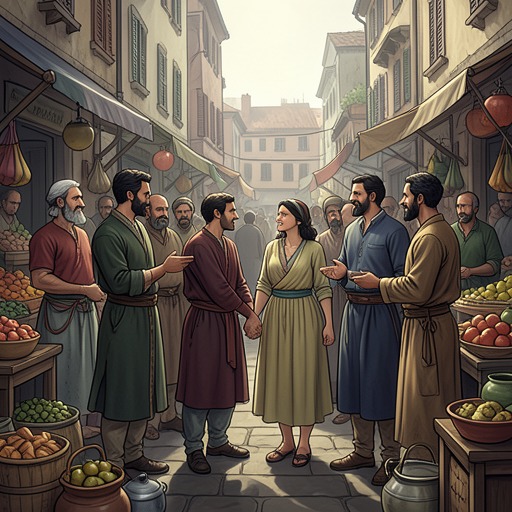
Dylan
SCOTTISH ROMANCE: My Sinful Surrender to a Highlander Werewolf (Scottish Werewolf Pregnancy Romance) (Historical Medieval Shape Shifter Paranormal Science Fiction Short Stories)Dylan is the principal Scottish suitor in The Highlander’s Mail Order Bride, and his decisive importance lies in the way he turns marriage into both a commercial alliance and a personal attempt to secure continuity. As the only son of the clan’s deceased head, he inherits responsibility for a large household, its winter provisions, its surrounding tenants, and its future. His arranged union with Victoria is negotiated for trade, yet the narrative ultimately presents it as the beginning of a family whose emotional and economic consequences reach beyond the wedding itself.
Identity and Background
Dylan is introduced as a physically imposing Highland landowner whose authority rests less on ceremony than on responsibility. He has taken charge of the clan after his father’s death, and the family accepts his leadership. The role is practical: he oversees food stores, organizes labor, and plans for the coming winter rather than treating the estate as a purely symbolic inheritance. His broad physical presence and confidence with weapons reinforce the image of a traditional Highland master, but his conduct toward the people around his estate complicates that impression.
His domestic economy is carefully managed. The clan has preserved vegetables, potatoes, salted fish, eggs from the chickens kept in the barn, and plans to supplement those stores with rice and coffee from town. Dylan also tries to ensure that the peasants living around his estate retain enough of their own food to survive, asking for assistance in maintaining his land rather than simply stripping them of their provisions. This makes him an unusual landowner within the social world of the story: he remains a figure of hierarchy, but his authority includes a stated obligation to protect the community dependent on it.
Dylan is also shown as skilled and daring in ordinary leisure. In the Scottish countryside, he practices archery and successfully strikes an apple balanced on his friend’s head, a feat that delights him but alarms the friend, who warns that Dylan will eventually kill him. The scene gives his competence a playful dimension. He is not merely a remote estate holder or a participant in a financial arrangement; he is a man accustomed to testing his strength and precision in the company of those who know him well.
Marriage as Business and Alliance
Dylan’s decision to seek a wife is inseparable from the economic needs of his clan. He travels to town with several clansmen for a meeting that he does not disclose to them as a marriage negotiation. In his own understanding, the proposed union will also be an excellent business pairing for trade with the English. He hopes that the prospective bride will at least be pleasant to look at, but his immediate calculation concerns the practical value of the match: Scottish wool can command a good price in the market, while the grain associated with the English side is hardier than what can be grown in his region.
The arrangement therefore joins private marriage to cross-border commerce. Victoria’s father, Andrew, does not welcome the idea of giving his daughter to a man he considers a brutish and barbaric Scotsman, yet the trading potential overcomes his reluctance. Andrew sees profit in the wool and grain exchange, while Dylan sees marriage as a means of strengthening the connection. Their agreement makes Victoria the human center of a bargain negotiated by men who are weighing family, land, and commodities together.
Dylan’s response to the marriage is not presented as purely detached. When Victoria arrives by carriage, he waits with his arms crossed, narrowing his cobalt eyes in expectation and anxiety. His reaction changes immediately when he sees her: he is startled by her petite blonde appearance and draws a hard breath, while she is equally overwhelmed by his size, dark curls, deep blue eyes, and thick brown beard. The first meeting thus converts an abstract arrangement into a face-to-face encounter in which both parties must confront the person hidden behind the negotiation.
Courtship, Ceremony, and Domestic Space
The wedding ceremony and its celebration pass in a blur for both Dylan and Victoria. Their uncertainty is especially pronounced after the clansmen depart and Victoria’s parents retire, leaving the newly married couple alone in the dining hall. Dylan, despite his authority and imposing stature, is shocked by his own nervousness. He runs a hand over his beard, clears his throat, and addresses Victoria as his wife while asking whether she is ready to see her new room.
His preparation of the room expresses a practical but meaningful form of welcome. The suite contains a large wooden bed, two chairs, a new vanity that appears to have been made for Victoria, and the metal washtub she had already used, concealed behind a thick dark green curtain. The room is not merely an accommodation in an unfamiliar estate; it is evidence that Dylan has imagined her arrival and made space for her within his household. His care is expressed through objects and arrangement rather than elaborate declarations.
The contrast between the public bargain and this private threshold is central to Dylan’s characterization. In public, he is the clan’s representative and a participant in a trade alliance. In the room, he becomes a husband attempting to guide a trembling bride into a shared domestic life. The story does not erase the contractual origins of the match, but it gives those origins a new emotional setting: the business agreement now has a bed, a room, and a future household attached to it.
Family, Inheritance, and Ending
Dylan’s marriage carries an immediate dynastic consequence. At the close of the narrative, Victoria appears visibly pregnant and proudly tells her father that one day his estate will belong to “this proud Scotsman here,” while patting her stomach. The statement links pregnancy, marriage, and property in a single image. The child is not only the anticipated continuation of Dylan’s family but also part of the economic and territorial future created by the union.
The ending confirms that Dylan’s initial objectives have converged. He sought a wife, a stronger commercial relationship with the English, and the possibility of children; the final scene presents the marriage producing the next generation while also making the alliance visible to Victoria’s family. His household is no longer an abstract future imagined through clan management and trade. Victoria’s pregnancy makes that future embodied and publicly acknowledged.
Dylan’s arc is consequently a movement from stewardship to shared succession. He begins as the son who must replace his deceased father and maintain a large clan through the winter. He then enters a marriage arranged partly for trade, meets a bride who initially finds his appearance intimidating, and ends with the promise of a child. The story treats his personal fulfillment and the preservation of his estate as intertwined rather than competing aims.
Narrative Role and Significance
Dylan functions as the point where the novel’s recurring systems of marriage, property, labor, and desire become concentrated in one relationship. His match with Victoria resembles other arrangements in the wider narrative, where marriage may answer pressures involving inheritance, citizenship, financial security, or family obligation. Yet Dylan’s case is distinctive because the bargain is explicitly tied to trade between English and Scottish interests and to the management of a clan’s material future.
His characterization also depends on productive contrasts. He is physically intimidating but nervous at the moment of intimacy; he is a landowner but takes some responsibility for the survival of nearby peasants; he approaches marriage as a business pairing but visibly reacts to Victoria as an individual; and he is a traditional figure of Highland authority who must nevertheless create a new domestic partnership. These contrasts keep him from being only a symbolic barbarian or an efficient patriarch. Dylan remains embedded in hierarchy and economic calculation, but the narrative allows those structures to become the conditions through which affection, household, and inheritance can develop.
The final image of Victoria beside Dylan and speaking of the estate’s future turns the marriage into a completed social transaction and a personal beginning at once. Dylan’s significance lies in that double movement: he preserves the clan’s material order while opening it to a bride, a child, and a family future that the original negotiation could only imagine in commercial terms.